Journey to the Heart of Earth: Hiking the Grand Canyon
The Grand Canyon stands as a monumental testament to time and geological power, a chasm of vibrant rock layers carved by the persistent flow of the Colorado River. It is a place that transcends mere scenery, offering an immersive experience that challenges the body, invigorates the spirit, and humbles the soul. For hikers, the Grand Canyon isn’t just a destination; it’s an epic pilgrimage into the very heart of the Earth, a landscape so vast and ancient it redefines one’s sense of scale and connection to the natural world. Unlike gazing across its immense expanse from the rim, descending into the canyon allows for an intimate engagement with its intricate geology, diverse ecosystems, and the profound silence of its depths. It is an opportunity to walk through millions of years of history, feeling the warmth of the sun on ancient stone and hearing the whisper of the wind through sculpted canyons. This is not just a hike; it is an unforgettable odyssey into one of the planet’s most awe-inspiring natural wonders.
An Overview of Grand Canyon’s Iconic Trails
While countless informal paths crisscross the Grand Canyon, the most renowned and maintained trails for hikers are the “Corridor Trails” originating from the South Rim: the Bright Angel Trail and the South Kaibab Trail. These trails are distinguished by their regular maintenance, access to potable water sources (seasonal on South Kaibab), and designated campgrounds at Indian Garden and Bright Angel Campground by the Colorado River. The North Kaibab Trail, accessible from the North Rim, offers a different perspective and is often combined with the South Rim trails for a challenging “Rim to Rim” traverse.
The South Rim trails plunge hikers directly into the geological tapestry of the canyon. The Bright Angel Trail, a historic route originally used by miners, offers more shade, multiple water stops, and a gradual, albeit still strenuous, descent. It winds past distinct geological markers like the Tonto Platform and Indian Garden, an oasis fed by a natural spring. The South Kaibab Trail, in contrast, is known for its relentless steepness and exposure, offering panoramic, unobstructed views from start to finish. It descends directly along a ridge line, showcasing the canyon’s immense depth and the river far below. Both trails converge at the bottom, leading to the historic Phantom Ranch and the banks of the Colorado River, completing a journey from the arid rim to the riparian zone.
What Awaits Below the Rim: Scenery, Terrain, and Wildlife
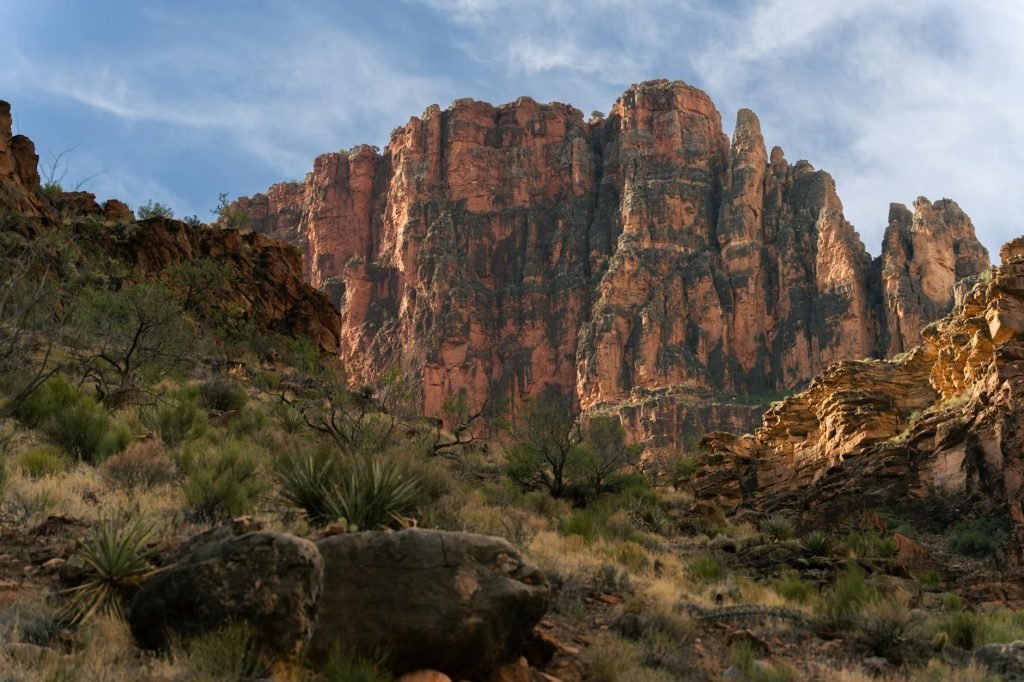
Descending into the Grand Canyon is like stepping into a living geological textbook. Hikers are treated to a constantly evolving panorama of vibrant colors—reds, oranges, purples, and browns—that shift with the angle of the sun, revealing new depths and textures. The layered rock formations, from the Kaibab Limestone at the rim to the Vishnu Schist at the bottom, tell a story of ancient seas, deserts, and mountain ranges. Every switchback offers a fresh perspective, making the vastness feel both overwhelming and intimately detailed.
The terrain is rugged and demanding, characterized by steep descents and equally challenging ascents. Trails are predominantly dirt paths, often rocky, with sections of loose scree and exposed bedrock. The notorious switchbacks are a constant feature, designed to make the steep grade manageable, yet they require unwavering focus and sturdy footing. Hikers will navigate narrow ledges, wide open slopes, and sometimes shaded canyons, experiencing a diverse range of microclimates as they descend through different elevation zones.
Wildlife sightings add another layer of wonder to the experience. High above, the majestic California Condor, with its impressive wingspan, can often be seen circling on thermal updrafts. Closer to the trails, agile Bighorn Sheep navigate seemingly impossible ledges, while various species of lizards dart across sun-warmed rocks. Mule deer are common near water sources and shaded areas, and a keen eye might spot smaller mammals like squirrels and various bird species adapted to this unique environment. The presence of these creatures serves as a reminder of the vibrant life that thrives within this seemingly barren landscape.
Optimal Seasons and Conditions for Your Grand Canyon Hike
Choosing the right time to hike the Grand Canyon is crucial for a safe and enjoyable experience. The shoulder seasons—**spring (March to May) and fall (September to November)**—are widely considered the best times. During these months, temperatures are generally moderate, with warm days and cool nights, making both descent and ascent more manageable. Water sources on the trails are typically reliable, and the crowds, while present, are less intense than in the peak summer months.
Summers (June to August) bring extreme heat, with inner canyon temperatures often exceeding 100°F (38°C). Hiking during these months, especially between 10 AM and 4 PM, is highly discouraged due to the severe risk of heat exhaustion and heatstroke. Rangers often issue warnings and recommend against strenuous activity during midday. Winters (December to February) present a different set of challenges. While the inner canyon can be relatively mild, the rim often experiences snow and ice, making trail conditions treacherous. Icy patches on the upper sections of the trails can necessitate traction devices like microspikes, and shorter daylight hours require careful planning. Regardless of the season, checking current weather forecasts and trail conditions with the National Park Service before embarking is paramount.
Practicalities: Distance, Elevation, and Difficulty
Hiking the Grand Canyon is not for the faint of heart; it demands respect and thorough preparation. The most common “Rim to River” hikes involve significant distances and elevation changes.
* **South Kaibab Trail (South Rim to Colorado River):**
* **Distance:** Approximately 6.3 miles (10.1 km) one-way.
* **Elevation Change:** Approximately 4,800 feet (1,463 meters) descent.
* **Difficulty:** Extremely Strenuous. Known for its relentless steepness, lack of shade, and limited water sources (seasonal water at Tipoff and Bright Angel Campground).
* **Bright Angel Trail (South Rim to Colorado River):**
* **Distance:** Approximately 9.3 miles (15 km) one-way.
* **Elevation Change:** Approximately 4,500 feet (1,372 meters) descent.
* **Difficulty:** Extremely Strenuous. Offers more shade and several seasonal water stops (1.5-mile Resthouse, 3-mile Resthouse, Indian Garden).
It is crucial to understand that hiking *down* into the Grand Canyon is only half the battle; the ascent back to the rim is significantly more challenging. Many hikers underestimate the physical toll of climbing out after a long descent, especially in rising temperatures. A “day hike to the river and back” is strongly discouraged by park rangers due to the extreme exertion required. Most hikers either plan a multi-day trip with an overnight stay at Phantom Ranch or Bright Angel Campground (requiring advance lottery permits) or opt for a “turnaround hike” to a specific point like Indian Garden or Skeleton Point before ascending. Always consider your fitness level honestly and plan accordingly.
Insights from Summit Reid’s Grand Canyon Experiences
Summit Reid, a seasoned hiker with multiple Grand Canyon descents, emphasizes that successful navigation of this immense landscape hinges on meticulous preparation and an unwavering respect for its power. From Reid’s observations, the single most critical factor is **hydration**. “Carrying more water than you think you’ll need, and supplementing with electrolytes, is non-negotiable,” Reid notes, recalling instances where hikers underestimated the desert’s thirst-inducing power. Reid also highlights the importance of **pacing oneself**, particularly on the ascent. “The canyon rewards patience, not speed. Start early to beat the heat, and take frequent, short breaks. Your body will thank you.”
Reid consistently advises on **appropriate footwear**, recommending sturdy, broken-in hiking boots with excellent ankle support and reliable grip. “The terrain is unforgiving,” Reid explains, “and blisters or a twisted ankle can quickly end your trip.” Another key insight from Reid’s journeys is the power of **mental fortitude**. “The climb out is as much a mental game as it is physical. Focus on small milestones, stay positive, and remember why you started.” Reid also stresses the importance of **leaving no trace**, ensuring that the pristine beauty of the canyon remains undisturbed for future generations. “Pack out everything you pack in, and stick to the marked trails. We are guests in this magnificent place.” Finally, Reid’s experiences underscore the critical advice of **turning around before exhaustion sets in**. “The canyon will always be there. Listen to your body, and never push past your limits. Reaching the river is incredible, but returning safely to the rim is the true accomplishment.”
An Unforgettable Journey Awaits
The Grand Canyon is more than a geological marvel; it is a profound experience that resonates long after the dust has settled from your boots. Descending into its depths offers a unique perspective, a chance to connect with the raw, untamed essence of nature and to challenge oneself against one of the planet’s most formidable landscapes. Every step taken on these ancient trails is a journey through time, a testament to endurance, and an opportunity for introspection amidst unparalleled beauty.
For those who answer the call of its immense scale and intricate beauty, the Grand Canyon promises an adventure that will forever be etched in memory. It demands respect, preparation, and a willingness to push beyond comfort zones, but in return, it offers an experience of profound awe and personal triumph. Add the Grand Canyon to your hiking bucket list, prepare diligently, and embark on a journey that will not only take you to the heart of Arizona but also deepen your connection to the enduring majesty of our natural world.